
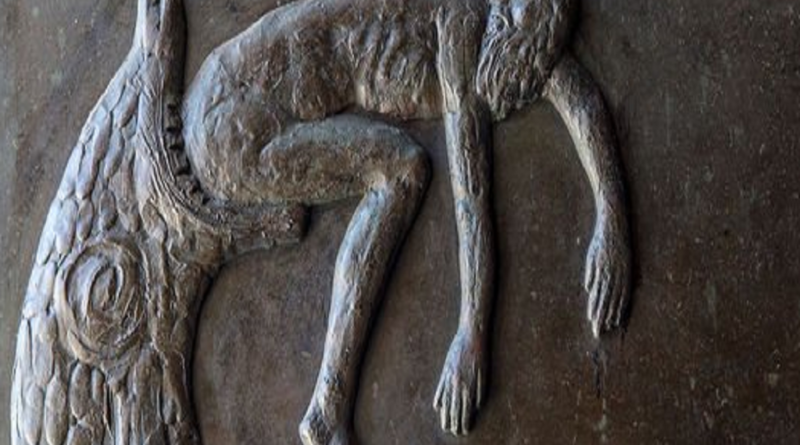
Can the Dead Pray? The ‘Sign of Jonah’
Can the dead pray? What would be the point? After all, once you’re dead, you’re dead, right? There’s no coming back and according to some, your future destiny is fixed at death. However, a close examination of Jonah’s time in the belly of the large fish, and Jesus’ equating of Jonah’s experience with his own death and resurrection through the ‘sign of Jonah’ suggests that prayer in the afterlife is not only possible, but may well be efficacious.
Jonah – Fish Food?
What’s your image of Jonah’s three days and nights in the belly of the fish? My early memories of this story are cartoons of Jonah alive, sat there in the belly of the fish, bored, and then he prays and gets vomited up onto a beach. In my teens, I began asking questions about this story, such as how on earth Jonah could survive in the fish for that long, given the stomach acid juices, lack of oxygen for his lungs and so on. I was simply told that God could perform a miracle and keep him alive, unharmed. Later, I discovered certain apologetics avenues which mentioned a man who allegedly survived being swallowed by a large fish. This gave me the impression that it might actually be possible. Later still, I began to hone my research skills further, becoming a ‘stickler for source’ to find the original reports for this story. However, it soon turned out that I was not the first to follow this path, and someone, who had gone all the way to try and research this story, ended up showing it was simply a fishy, ‘whale of a tale’. [1] No reports exist of anyone surviving being swallowed by a large fish, certainly not for any length of time such as a few days. So, I had to resign myself to simply accepting that perhaps Jonah’s preservation alive in the fish was a case of a miracle happening. [2]
Jesus and the ‘Sign of Jonah‘
It was whilst writing an article on Jesus’ descent to the realm of the dead after his crucifixion that I was reminded of Jesus’ message to the gathered religious scribes and Pharisees. These had just witnessed him perform an exorcism, and asked him for a further sign of his authority:
But he answered them, ‘An evil and adulterous generation asks for a sign, but no sign will be given to it except the sign of the prophet Jonah. For just as Jonah was for three days and three nights in the belly of the sea monster, so for three days and three nights the Son of Man will be in the heart of the earth.
Matthew 12:39-40 (NRSV)
Most commentators and apologeticists aim for the ‘three days and three nights’ part of this verse, attempting to justify why, if the crucifixion was on a Friday, you could have three days and nights between then and the Sunday. In my ‘apologetics based’ past, I’d given this some thought. [3] However, uppermost in my mind this time was Jesus’ descent to the realm of the dead and the intermediate state of the dead in sheol / hades.
If Matthew wanted to say Jesus was going to be in the tomb, he would have used the word taphou, ‘tomb’. Something else is being telegraphed in this ‘heart of the earth’ phrase, something which a knowledge of Hebraic cosmology, as shown in this image, reveals:

Jesus died and was buried, but was made alive in the spirit (1 Peter 3:18) as he descended to the ‘heart of the earth’ – the realm of the dead, hades / sheol. In the time between his entrance to hades and his resurrection, he would have been in one of the compartments there. These include Paradise (Luke 23:43), and as Luke 16:19-31 suggests, there seems to be communication between other parts of hades, such as the Place of Torment, and Tartarus where the spirits of the fallen angels that did not keep their first estate are imprisoned and proclaimed to by Jesus (2 Peter 2:4, Jude 6).
Jesus was not abandoned and left in hades, nor did his flesh experience decay (Acts 2:27, 31) – a miracle in itself. Also, as the aforementioned verses state, he was able to engage in conscious dialogue whilst in the underworld.
So what does all this have to do with Jonah?
Jonah in the Underworld
Let’s read the words recorded in Jonah:
But the Lord provided a large fish to swallow up Jonah; and Jonah was in the belly of the fish for three days and three nights.
Then Jonah prayed to the Lord his God from the belly of the fish, saying,
‘I called to the Lord out of my distress,
and he answered me;
out of the belly of Sheol I cried,
and you heard my voice.
You cast me into the deep,
into the heart of the seas,
and the flood surrounded me;
all your waves and your billows
passed over me.
Then I said, “I am driven away
from your sight;
how shall I look again
upon your holy temple?”
The waters closed in over me;
the deep surrounded me;
weeds were wrapped around my head
at the roots of the mountains.
I went down to the land
whose bars closed upon me for ever;
yet you brought up my life from the Pit,
O Lord my God.
As my life was ebbing away,
I remembered the Lord;
and my prayer came to you,
into your holy temple.
Those who worship vain idols
forsake their true loyalty.
But I with the voice of thanksgiving
will sacrifice to you;
what I have vowed I will pay.
Deliverance belongs to the Lord!’Then the Lord spoke to the fish, and it spewed Jonah out upon the dry land.
Jonah 1:17 – 2:10 (NRSV)
Notice the various phrases Jonah uses: ‘belly of Sheol’, ‘the deep’, ‘the heart of the seas’, ‘flood’, ‘the roots of the mountains’, and ‘the land whose bars closed upon me for ever’ (sheol was believed to have bars over it to prevent escape). All of these phrases relate to the underworld, the realm of the dead, though one word, miš·ša·ḥaṯ translated as ‘the Pit’ in the NRSV, also can mean ‘corruption’ (e.g. KJV). [4]
The NRSV and others use the word ‘life’ for two different Hebrew words:
- his ‘life’ (nap̄·šî, nephesh or ‘soul’) was ebbing away
- his ‘life’ (ḥay·yay, chay:age, or ‘everyday life’) was brought up from the ‘pit’ / ‘corruption’
It should be noted that nephesh can even be used of a dead person, eg Numbers 5:2 (the dead / corpse), Numbers 6:6 (dead body), Numbers 9:6-7 (dead body).
Also, if we remember the Jewish understanding of the soul was that it hovered around the body of the deceased for three days before finally departing, we can understand how his soul would have been ebbing away.
We even read that his head was wrapped in seaweed – hardly conducive to helping him breathe. Incidentally, Jesus’ head was wrapped separately to the rest of the burial shroud (John 20:7) – coincidence, or deliberate “Easter egg”? (Bad pun, sorry.)
From all the imagery used in Jonah’s description of his time in the fish, we see that he was dead, and in that afterlife state, cried out his prayer of praise to the Lord, who gives Jonah the opportunity to carry out the task he was originally given by God.
Conclusion
If Jesus was dead in the tomb, then Jonah would also be dead in the fish, as Jesus equates the two instances in this manner:
For just as Jonah was for three days and three nights in the belly of the sea monster, so for three days and three nights the Son of Man will be in the heart of the earth.
Jonah was dead within the fish, but he was alive in the spirit and conscious in the afterlife. He was finally resurrected after his time in sheol. It is precisely for these reasons that Jesus equates his experience there with that of Jonah.
The sign of Jonah is much more than a simple numeric conundrum of days and nights. It’s an incredible sign of the power of God over death itself. The sign is loaded with imagery of descent to the underworld (being dead in the body, yet alive in the spirit) and resurrection from it. It also includes the miraculous preservation of the bodies of both Jesus and Jonah in environments which were harsh to dead flesh.
So, let’s put away the childish imagery of Jonah being alive in the fish, bored silly until he cries out to God for help. Let’s put away these fanciful, fishy tales of people being eaten by fish and surviving. Let’s not get too hung up about how many days and nights Jesus was in the tomb for compared to Jonah… These are all red herrings (pun definitely intended!).
Jesus’ ‘sign of Jonah’ is a sign of bodily death, descent to the underworld, and resurrection, with miraculous preservation as a side order. Jonah’s sign of being raised from the dead was enough to cause the city of Ninevah to repent (Jonah 3:1-10), and all because he prayed to God in repentance whilst he was in the afterlife.
Footnotes
[1] Davis, E. B. (1991), ‘A Whale of a Tale: Fundamentalist Fish Stories’ in Perspectives on Science and Christian Faith, 43. pp. 224-237. Available online at https://www.asa3.org/ASA/PSCF/1991/PSCF12-91Davis.html (accessed 29th December 2020).
[2] I do believe the story of Jonah portrays actual events that happened in history, as I don’t believe Jesus would have used a mythic ‘sign of Jonah’ to equate to his own literal death and resurrection (Matt 12:39-40) as it would have given mixed messages to both his listeners and to subsequent readers throughout history.
[3] Space does not permit a full treatment of these arguments, but many commentators seem to suggest that Jesus was mentioning a period of time, rather than three specific nights and days. My hunch is that as Passover was a Sabbath as well as the usual Saturday, there’s space in one week for two ‘Sabbaths’ and thus you can have the Last Supper on a Wednesday, the Crucifixion on a Thursday morning with the burial of his body on the Thursday afternoon, Passover beginning on the Friday and the resurrection on the Sunday morning. Those who wish to play around with moon phases and Hebraic calendars around the years of 30AD to 33AD may find these sites useful: Moon Phase Calculator, Hebrew Calendar of Festivals Calculator.
[4] Here are the various versions that translate Jonah 2:6 differently.


Matt, what about the dead praying for us? I missed it if its in there.
Hi Chris,
We do have a few instances in the various scriptures which can be perceived as intercessory prayers by the disembodied for us:
In chapters previous to Jeremiah 15, we’ve seen how God has stated his displeasure at the people of Israel and Judah, who have broken the covenant with God. Then in Jeremiah 15:1, we read that “Then the Lord said to me: Though Moses and Samuel stood before me, yet my heart would not turn toward this people.” So it’s clear that Moses and Samuel were interceding for the people way after their disembodiment.
It was believed by the Jews that the prophets and other well respected religious figures who were disembodied (such as Onias and Jeremiah) were interceding for them before God in 2 Maccabees 15:12-16, which reads:
“What he saw was this: Onias, who had been high priest, a noble and good man, of modest bearing and gentle manner, one who spoke fittingly and had been trained from childhood in all that belongs to excellence, was praying with outstretched hands for the whole body of the Jews. Then in the same fashion another appeared, distinguished by his gray hair and dignity, and of marvelous majesty and authority. And Onias spoke, saying, “This is a man who loves the family of Israel and prays much for the people and the holy city—Jeremiah, the prophet of God.” Jeremiah stretched out his right hand and gave to Judas a golden sword, and as he gave it he addressed him thus: “Take this holy sword, a gift from God, with which you will strike down your adversaries.””
This clearly states that the disembodied Jeremiah was praying for his people.
Even in Jeremiah 15:31 we read: “Thus says the Lord: A voice is heard in Ramah, lamentation and bitter weeping. Rachel is weeping for her children; she refuses to be comforted for her children, because they are no more.” Now, this is taken as fulfilled prophecy in Matthew 2:17-18 by many Christians, but at the time of writing both Jeremiah and Matthew, Rachel had been long disembodied according to Genesis 35:19. We could try and see this as symbolic/poetic usage of Rachel weeping for her offspring, but given that there is scriptural evidence for the belief that the disembodied do pray intercessory prayers for us to God, including the beginning of this same chapter of Jeremiah, then there’s no reason to not believe that the writer of Jeremiah at least believed that Rachel was in intercession for her descendents and wept as a result.
Hope this helps.
Matt
As such