

Biblical Demonology – Part 7ii: Daimones, Ghosts and the Dead
Normally in Protestant Christianity the subject of human spirits as ghosts is a no-go area, barred from further exploration by usage of texts such as Ecclesiastes 9:5, Luke 16 or Hebrews 9:27 (click links for a more nuanced understanding of these texts that shows there’s room for ghosts in the biblical text alone). However, in our exploration of the Bible through the eyes of the original writers, we have to accept that they believed the dead were able to contact the living, and that ghosts were not necessarily impersonating evil spirits.
We shall now begin our exploration of such a concept, which may seem novel and strange to our ears, shaped by post-Augustinian Christianity.
Daimones as Ghosts?
As seen previously, daimones included Class III – the spirits of the dead [1]. However, you may be forgiven for thinking that this is a direct one-to-one mapping of daimones for what ‘ghosts’ are in the cultures of that day; Felton [2] reveals that whilst ‘ghosts’ were certainly accepted as daimones and phasma (phantoms), these terms could be interchangeable, and as such ‘ghost’ could be applied to any of Walton’s three classes of daimones. Confused? I find the best way to understand this is that ‘ghost’ means any apparition of any spirit being, whatever the provenance of that being may be. Our exploration of Ghosts in the New Testament fits well into this framework.
Bolt’s exploration of daimones in Greco-Roman and Hellenistic Jewish literature [3] concludes that whilst daimones in philosophical spheres were intermediary beings, at the popular level they would have been classed as ‘ghosts’.
For clarity we shall update our Venn diagram of daimones to include ‘ghosts’:

Diamones and the Dead
According to the ancient Jewish historian, Josephus [4], daimones included ‘dead persons haunting places or people and avenging their deaths (Ant. 13.416).’ It should be noted that Josephus is often quoted by Christians in support of various biblical passages, e.g. for the existence of Jesus.
Bolt [5] gives an example of Josephus’ understanding of daimones as the spirits of dead humans when Josephus describes what appears to be a magical practice: how the plant rue could be used to exorcise ‘the so-called daimons, in other words, the spirits of wicked men which enter the living’. He then goes on to list further places where Josephus uses daimones for the spirits of deceased humans, where they ‘worked on the side of justice … as vengeful ghosts … [were the] spirits of the blessed dead’ [6]. Thus we see Josephus’ Jewish understanding that the deceased spirits of humans may actually seek to possess the dead. This lines up well with 19th Century Lutheran pastor, Johannes Blumhardt’s observations and encounters with possessing demons in his exorcism of Gottliebin Dittus, and the accounts of many exorcists / deliverance ministers who are honest about some of the encounters they’ve had with possession cases. Positive cases of ghostly apparitions include, amongst others, that of C.S. Lewis to J.B. Phillips.
The Dead in the Old Testament
The Mētîm
We have previously examined in detail the famous case of the ghost of Samuel appearing to Saul at Endor, which we can use to refute the belief of those who do not believe the dead can return to communicate with the living.
The dead (Hebrew, mētîm) were forbidden from being contacted by passages such as Deuteronomy 18:10-11:
No one shall be found among you who … who casts spells [cheber], or who consults ghosts [‘ôb] or spirits [yiddĕ ̔ōnî], or who seeks oracles from the dead [mētîm].
Deuteronomy 18:10-11 (NRSV)
which begs the question why it was forbidden if it was not possible for the living and the dead to communicate with each other? It also implies that there is a consciousness in the afterlife, something not accepted by those who believe in “soul sleep” or “time bypass” to the resurrection.
The ‘Ôb / ‘Ôberim
A passage mentioning these spirit beings is Isaiah 8:19:
Now if people say to you, ‘Consult the ghosts [‘ôb] and the familiar spirits [yiddĕ ̔ōnî] that chirp and mutter; should not a people consult their gods [‘ĕlôhı̂ym], the dead [mētîm] on behalf of the living.
Isaiah 8:19 (NRSV)
Remember that the ‘ôb were ancestral spirits that mediums used as go-betweens between the living and the dead to enquire of them on their clients behalf. Their translation in the NRSV as ‘ghosts’ further muddies terminology as whilst they are ghosts, they are more than that… The Dictionary of Deities and Demons in the Bible refers to the ‘ôb, or ‘ôbĕrı̂m as Travellers [8] – those who ‘pass from one side to the other’. There is obviously some recognition in Scripture that there are deceased human spirits which can be consulted and can cross the boundaries between the living and the dead. We’ll refer to these particular spirits as Class III diamones: “Travellers” to avoid confusion. Incidentally, this gives a very interesting insight into the horde of Gog that gets buried in the Valley of the Travellers (Ezekiel 39:11-16), which is east of the Dead Sea, an area already rich in megalithic dolmen (burial mounds) as shown in this video:
This leads to the idea that Gog is the leader of a host of spiritual beings which are brought together and finally buried, in a similar fashion to Revelation 19 & 20 (John, the writer of Revelation, draws on Ezekiel’s passages here for his final battle with and defeat of Satan). So that’s yet another article to put on the list to write in the future!
Time to update our Diamones Venn diagram once more:
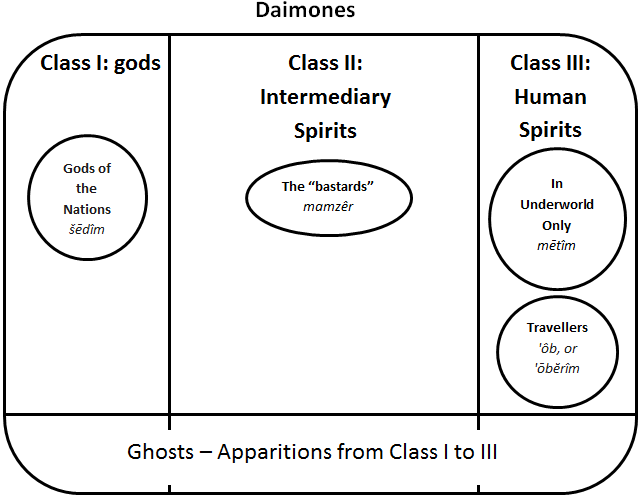
The yiddĕ ̔ōnî are discussed in another article, but for now can consider them as familial ones used for the divinatory practice of fortune telling, and are akin to the divinatory “spirit of Python” in the girl Paul encountered in Acts 16:16-18 (see footnote ‘a’ here).
The Dead in the New Testament
Having seen the dead may communicate with the living in Old Testament material, we come to the concept of daimones in New Testament times and cultures, which included Walton’s Class III spirits of the dead.
Theissen [7] makes the association with daimones and the spirits of deceased humans when he discusses the account of the Geresene demoniac (Mark 5:1-20). This opens the intriguing prospect that the poor afflicted man was not necessarily entirely possessed by non-human spirits, but may have included many that were the spirits of deceased soldiers, slain in battles against the Romans. We explore this concept with the Geresene Demoniac in much greater detail in a series of articles on this particular case of possession (SPOILER: this may partly explain why they wished to enter the pigs, a staple food source for the nearby Roman legion stationed at the city of Gadara; was their subsequent destruction revenge from the afterlife?). Incidentally, Blumhardt was also of the opinion that this might well be what’s happening to the Geresene demoniac during his theological reflection upon his exorcistic encounter with the sprits in Gottliebin Dittus.
A much more detailed exploration of the understanding of ghosts and the dead in the New Testament can be found here.
Conclusion
Ancient biblical writers were fully aware of the ability of the dead to be in contact with the living, though they outlawed it for various reasons, including the safety of the one wishing to be the conduit through which the spirit of the dead would inhabit. The ‘ôbĕrı̂m were Class III daimones, human spirits that travelled between the worlds, and although were dead, were not Class III mētîm which remained in the underworld. Samuel could have been thought to have been a mētîm, and was not best pleased when he was dragged out of the underworld by the ‘ôbĕrı̂m at the behest of the medium whom Saul engaged with (1 Samuel 28).
Should someone state that ghosts are all demons, ask for clarification. Do they mean daimones as ghosts? If this is so, they’re correct. But drill down further with them do they really mean a Class II daimon which is behaving in an evil manner, or a Class III human spirit, possibly an ‘ôbĕrı̂m. Observe their reaction … and then point them to this website!
Next Time: We shall look at how the Septuagint translators of the Hebrew Old Testament translated terms for various Class II spirit beings. We explore “Lilith”, “satyrs”, “owls” and “jackals” of Isaiah 13 and 34. Our Venn diagram of daimones is certainly going to start filling up from this point on.
Bibliography
Bolt, P. G. (1996). ‘Jesus, the Daimons and the Dead’, in Lane, A. N. S. The Unseen World. Grand Rapids, Michigan: Baker House Books and Paternoster Press, pp. 75-102.
Felton, D. (1998) Haunted Greece and Rome: Ghost Stories from Classical Antiquity. Austin, Tx: University of Texas Press.
Josephus, F. and Whiston, W. (2004), The Works of Josephus. Peabody, MA: Hendrickson Publishers.
Kittel, G., Friedrich, G. and Bromiley, G. (1989), Theological dictionary of the New Testament – Abridged in One Volume. Grand Rapids, Michigan: William B. Eerdmans Publishing Co.
Martin, D. B. (2010). ‘When Did Angels Become Demons?’, The Journal of Biblical Literature, vol. 129:4, pp. 647-677.
Theissen, G. (1983). Miracle Stories of the Early Christian Tradition. Edinburgh: T & T Clark.
Van der Toorn, K., Van der Horst, P. W., et al (1998) Dictionary of Deities and Demons in the Bible. Lieden, Netherlands: Brill Academic Publishers.
Walton, J. H. and Walton, J. H. (2019), Demons and Spirits in Biblical Theology: Reading the Biblical Text in Its Cultural and Literary Context, Eugene, OR: Cascade.
Footnotes
[1] Walton, 56.
[2] Felton, xii.
[3] Bolt, 96.
[4] in Martin, 672.
[5] Bolt, 95.
[6] ibid, n.80.
[7] Theissen, 89 n.21; 255 n.58.
[8] Van der Toorn et al, 876-877.

