
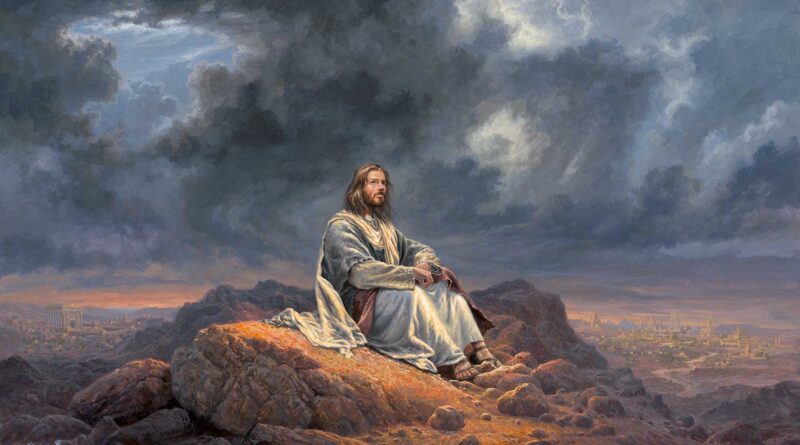
The Out-of-Body Experiences of Jesus
Many are familiar with the account of the temptation of Jesus by the devil / the satan / the tempter, but have we ever stopped to consider whether this could have involved a series of out-of-body experiences (OBEs)? If we examine this viewpoint, it could make sense of some of the puzzling details that arise from a deep reading of the account, together with fitting alongside other parts of Scripture which include OBE accounts.
Whilst Mark 1:12-13 gives a very brief, account of the temptation, Matthew 4:1-12 and Luke 4:1-13 give an extensive account of the ordeal.
Jesus, full of the Holy Spirit, returned from the Jordan and was led by the Spirit in the wilderness, where for forty days he was tempted by the devil. He ate nothing at all during those days, and when they were over, he was famished. The devil said to him, “If you are the Son of God, command this stone to become a loaf of bread.” Jesus answered him, “It is written, ‘One does not live by bread alone.’”
Luke 4:1-13 (NRSV)
Then the devil led him up and showed him in an instant all the kingdoms of the world. And the devil said to him, “To you I will give their glory and all this authority; for it has been given over to me, and I give it to anyone I please. If you, then, will worship me, it will all be yours.” Jesus answered him, “It is written, ‘Worship the Lord your God, and serve only him.’”
Then the devil took him to Jerusalem, and placed him on the pinnacle of the temple, saying to him, “If you are the Son of God, throw yourself down from here, for it is written, ‘On their hands they will bear you up, so that you will not dash your foot against a stone.’”
Jesus answered him, “It is said, ‘Do not put the Lord your God to the test.’”
When the devil had finished every test, he departed from him until an opportune time.
Location of the Temptation
Jesus undertook his 40 day retreat prior to engaging in full-time ministry in the Judean wilderness, most likely staying in a cave in one of the hills there.
Traditionally, it is thought that the temptation took place slightly to the north of Jericho, where there is now located the Greek Orthodox “Monastery of the Temptation”, which contains a grotto claimed to be the site of the temptation of Jesus.


However, the “Monastery of the Temptation” at that time had been a fortress, built by the Selucids and then captured by the Hasmoneans. The fortress was strategically build upon the highest mountain in the area. This might explain why in 326CE when Helena of Constantinople visited it during a pilgrimage it was thereafter considered by Christians to be the site of the temptation of Jesus. The Byzantines built the first monastery there in the 6th century CE.
Whilst this is the traditional site of the temptation, one has to ask – would Jesus have gone to retreat in an old, ruined fortress, soaked in bloodshed from the Hasmonean take-over? Were the early Christians misled by a literal reading of the Tempter taking Jesus to a “high mountain” into choosing this location?
Could there be a better location, one which fits the previous story of his baptism and the beliefs of John the Baptist?
Jesus on Retreat at Qumran?
Some have claimed that John had links with the Essenes at Qumran. These were an extreme Jewish sect that splintered from the main priesthood of Jerusalem in the second century BCE. Farnes1 has analysed the debate as to whether John the Baptist was a member of this sect, and notes there is evidence he probably did belong to the group at one time, but left and began his own ministry which was similar to, but not precisely that of the Qumranites.
The caves of Qumran, where the library of the Essenes (the Jewish sect that John the Baptist belonged to) is located is very close by the Jordan where Jesus had just been baptised. Rather than an image of Jesus lying around in a cave all day, doing nothing for 40 days, perhaps, like ministers today, he was using this time to read, reflect and pray before his ministry began in earnest. Perhaps John took Jesus back to his own roots in order to prepare him for his own ministry? This is an interesting conjecture, but we cannot conclusively prove it. The Essenes had to hurriedly hide the scrolls of their library in the caves at Qumran in the face of the advancing Roman legion of Vespasian, in June 68CE. As the Romans wiped out the Essenes, we have no records of their writings after that time, and it is a miracle of preservation that we have their writings and collection today in the Dead Sea Scrolls (DSS).
Contained within Jesus’ teachings are references to concepts held within the DSS, but not directly recorded in the Hebrew Old Testament. Perhaps his familiarity with these came from his formational time in the Judean wilderness, in retreat in the Essene library for at least some of the time?


Jesus’ First Temptation and Out-of-Body Experiences
The acetic act of fasting for 40 days would have indeed left Jesus famished (Matthew 4:2; Luke 4:2). Matthew says Jesus was tempted for 40 days, followed by the first recorded temptation, which targeted his hunger:
The devil said to him, “If you are the Son of God, command this stone to become a loaf of bread.” Jesus answered him, “It is written, ‘One does not live by bread alone. [but by every word that comes from the mouth of God.]’”
Luke 4:3,4 (NRSV) (Parenthesis added from Matthew 4:4)
If we are to read v3 as chronologically following verse 2, then there is no reason why Jesus could not have eaten at that point. He had finished his 40 day fast (Luke 4:2) and therefore wouldn’t have given into temptation and broken his fasting by eating. The temptation to break his fast by turning the stones into bread after ending his fast is nonsensical.
Note that Jesus’ temptation is rebutted by not living on bread alone, but by every word that comes from the mouth of God. Is this a possible reference to his time of reading in the library of the Essenes, which he was filling himself with instead of bread?
It stands to reason that the three recorded temptations took place during the 40 days, rather than at the very end. After the last recorded temptation, the devil takes his leave, and Matthew records that angels waited upon Jesus.
When fasting, it is commonly agreed that the hardest part concerning the feelings of hunger come near the start, as the body begins undergoing a change in metabolism2. As it is also recognised that hunger is capable of triggering out-of-body experiences3 – can this be the state in which Jesus’ temptations were taking place?
The Second Temptation
Strangely Matthew and Luke record the second and third temptations in different orders. For the sake of ease, we shall use Luke’s order.
Having played with Jesus’ bodily temptations, the Tempter now plays with his mind…
Then the devil led him up and showed him in an instant all the kingdoms of the world.
Luke 4:5-8 (NRSV)
And the devil said to him, “To you I will give their glory and all this authority; for it has been given over to me, and I give it to anyone I please. If you, then, will worship me, it will all be yours.”
Jesus answered him, “It is written
‘Worship the Lord your God,
and serve only him.’”
We often think of Jesus trudging up a mountain for this temptation, as per the Matthew’s account, something unthinkable immediately after a 40 day fast:
Again, the devil took him to a very high mountain and showed him all the kingdoms of the world and their splendour;
Matthew 4:8 (NRSV)
Notice that Jesus could see all the kingdoms of the world – in an instant. How could this possibly be if we are talking about a geographical location? There is not a mountain on the earth which could show even a very tiny proportion of the kingdoms of the world, nor even a few of the kingdoms in that region. To be able to see them in an instant would require something akin being in the International Space Station, and even then we’d only be able to see one hemisphere of kingdoms.
This temptation of Jesus is similar to the out-of-body visionary experiences of Ezekiel, e.g.:
In the twenty-fifth year of our exile, at the beginning of the year, on the tenth day of the month, in the fourteenth year after the city was struck down, on that very day, the hand of the Lord was upon me, and he brought me there. He brought me, in visions of God, to the land of Israel, and set me down upon a very high mountain, on which was a structure like a city to the south.
Ezekiel 40:1-2
In many accounts of near-death experiences (NDEs), vision is claimed to be supernormal:
My vision was greatly increased. I was able to see things as close or as far as I needed. There was no strain involved it was almost like auto zooming a camera.
Long (in Hagan)4
I had 360 degree vision, I could see above, below, on my right, on my left, behind, I could see everywhere at the same time.
Note the last quote, which seems very much like the experience one would have if one was lifted up into a higher, e.g. 4th dimension, looking “down” on the other three. For those who aren’t familiar with this concept, see this clip of Dr Quantum and Flatland, based upon the Edwin A. Abbott’s novella, Flatland (1884), and just imagine the 2D land as being our 3D realm:
If, triggered by his hunger, Jesus had out-of-body experiences during his temptation and his spirit was taken to a higher dimension, then he would be able to see all the kingdoms of the world of that time, all at the same time.
However, the universality of the term ‘kingdoms of the world’ in Scripture is one which encompasses not just a snapshot of the kingdoms of the world at Jesus’ time, but those past, present and future. When Jesus saw all the kingdoms of the world, and their splendour in an instant, he would have seen these kingdoms in the whole of time and space. Even if his spirit had been lifted into a higher dimension to facilitate seeing the kingdoms of the world at that time, how could he see across time as well?

Perhaps another piece of evidence from NDE studies which suggests an alternative form of time existing in the out-of-body state can help us understand Jesus’ temptation experiences further. Dr Bruce Greyson describes various accounts of NDEs where time itself becomes meaningless:
I knew what it was like to experience eternity, where there was no time. It’s the hardest thing to try and describe to someone. How do you describe a state of timelessness, where there’s nothing progressing from one point to another, where it’s all there, and you’re totally immersed in it? It didn’t matter to me if it was three or five minutes that I was gone. That question is only relevant to here [in this realm of existence].
Geraci (in Greyson)5
If Jesus’ second temptation really did take place as out-of-body experiences, then evidences from NDE studies would line up with this explanation, rather than him being taken on a strenuous walk up a high mountain after a 40 day fast when he’s still not eaten?
The Third Temptation
Here we see another of Jesus’ temptation that can only be explained sensibly if it was an out-of-body experience:
Then the devil took him to Jerusalem, and placed him on the pinnacle of the temple, saying to him, “If you are the Son of God, throw yourself down from here, for it is written,
Luke 4:9-12 (NRSV)
‘He will command his angels concerning you,
to protect you,’
and
‘On their hands they will bear you up,
so that you will not dash your foot against a stone.’”
Jesus answered him, “It is said, ‘Do not put the Lord your God to the test.’”
Regardless of location, whether Qumran or the now Monastery of the Temptation, both of these are over 20 miles across the desert wilderness from Jerusalem. Are we to believe that the hungry Jesus actually travelled to Jerusalem to climb up to the top of the Temple, without stopping by to pick up a snack or two whilst in town? After all, he’d finished his fasting, so could have eaten (which then begs the question why the angels needed to minister to him after this last temptation).
The only sensible explanation is, like Jesus’ second temptation, it was another of his out-of-body experiences, which again would be very similar to the temple OBEs of Ezekiel:
I looked, and there was a figure that looked like a human being; below what appeared to be its loins it was fire, and above the loins it was like the appearance of brightness, like gleaming amber. It stretched out the form of a hand, and took me by a lock of my head; and the spirit lifted me up between earth and heaven, and brought me in visions of God to Jerusalem, to the entrance of the gateway of the inner court that faces north …
Ezekiel 8:2-3;11:1
The spirit lifted me up and brought me to the east gate of the house of the Lord, which faces east.
Conclusion
We have seen that the acetic practice of fasting (possibly as a result of contact with the Essenes through John the Baptist) would have left Jesus famished and could have been a mechanism for the temptations to have been experienced not as physical manifestations, but as a series of out-of-body experiences. These have cognate effects similar to reports by those who have undergone near-death experiences.
Rather than read the temptations as Jesus literally climbing a high mountain or to the roof of the Temple, the evidence suggests he encountered these as out-of-body experiences.
Further Thoughts
There are some who, upon reading this, will still be struggling that Jesus could have had an out-of-body experience, and may use the temptation at the top of the temple to argue that, had Jesus only been in an out-of-body state, then, had he thrown himself off the top of the temple, it would have had no effect upon a non-physical body. Whilst this is true, there are a couple of responses that can be given to this:
- This was an out-of-body experience. The issue isn’t about the lack of potential to cause any physical harm because of the lack of a body, but more to do with the fact Jesus, whether in or out of the body, he would had sinned if he had worshipped Satan at that moment. That Paul, when he visited Paradise (2 Corinthians 12:2-4), he was not aware of whether he was in the body or out of it, such was the reality of the experience he had. Jesus, at the end of 40 days, may well have experienced a similar dissociative state and been unaware of whether or not he was in the body or out of it at the time, after all, Jesus was fully human as well as being fully God.
- This was not an out-of-body experience, but a similar experience to what Jews term the phenomena of kefitzat haderech (“shortening of the way”). This is a paranormal type phenomena where transportation between two places is undertaken in an impossibly short amount of time. Such a phenomena was seen with Philip and his teleportation from the road to Ethiopia and the town of Azotus many miles away. It is also thought to appear in other Old Testament stories.
Either way, these two responses still uphold the idea that something paranormal happened during the temptations of Jesus which allowed him to visit very distant locations very quickly, whether in or out of the body.
Bibliography
Farnes, A. J. (2011), ‘John the Baptist and the Qumran Connection’, in Studia Antiqua, Vol. 9 No. 1, BYU.
Greyson, B. (2021), After: A Doctor Explores What Near-Death Experiences Reveal About Life and Beyond, London: Bantam Press.
Hagan III, J. C. (2017), The Science of Near-Death Experiences, Columbia: University of Missouri Press.
Trepanowski, J. F. and Bloomer, R. J. (2010), ‘The impact of religious fasting on human health’, in Nutrition Journal,Vol. 9 Article 57, Available online here: https://nutritionj.biomedcentral.com/articles/10.1186/1475-2891-9-57 (Accessed 16/10/2021).
Footnotes
1] Farnes
2] Trepanowski and Bloomer, 1.
3] https://www.psychologytoday.com/gb/blog/rhythms-recovery/202007/dissociation-out-body-or-derealization
4] Hagan, 68.
5] Greyson, 32-33.

