

The Gadarene Demoniac: 1 – Setting the Scene
The account of the Gadarene (Gerasene / Gergesene) Demoniac is one of the Bible’s most successfully exported stories of demons, featuring in a diverse range of settings from Shakespeare’s Twelfth Night [1] to the BBC’s Red Dwarf [2].
So striking was the encounter that all three Synoptic writers included it in their books: Matthew 8:28-34; Mark 5:1-20 and Luke 8:26-39. Each including similar details that, when explored in depth, provide a wealth of information which can shine a light into deliverance ministry, as Johann Blumhardt discovered in his exorcism of Gottliebin Dittus.
From an exorcistic perspective, Myers states that the confrontation between Jesus and Legion ‘contains more detail and embellishment than any other single episode in the Gospel before the trial narrative.’ [3]. Johnston agrees, saying it: ‘contains more detail than any other incident recorded in Mark’s gospel except for the passion’ [4]. For Bolt it ‘constitutes the exorcism of all exorcisms in the Gospel of Mark.’ [5] As such further examination of the details of this account is warranted to further our understanding of the passage and Jesus’ modus operandi within it.
During this three-part series, each part will examine:
- the location and its background,
- the demoniac and his background,
- the spirits infesting the demoniac.
A fourth part will come in due time and consider the encounter of Legion with Jesus the exorcist.
We shall be working with the earliest written account of the event – Mark’s, but if you want to study alongside this series, you may well want to print out the various texts from Mark, Matthew and Luke to study in parallel. We will read the passages through the lens of a paranormal encounter with Jesus, exploring how it would have been originally understood by the original cultures witnessing, hearing and reading about it.
To understand the passages, we must bear in mind the geographical, historical and cultural aspects of the story and the text itself. We shall set the scene by exploring these elements throughout the series.
Hypothesis
The following working hypothesis frames the series:
It is proposed that a lens which incorporates an understanding of daimones as human spirits may help a new understanding of the passage, answering some of those questions which are raised, such as:
- What is being exorcised by Jesus?
- Why the large-scale destruction of the swineherd?
Using a ‘paranormal lens’ to interpret this event may help those engaged in deliverance ministry analyse haunting phenomena, particularly in cases of alleged possession, with an awareness of potential activity by spirits of the dead.
The Location of the Event – Gergesa / El Kursi.
Any serious claim to the true location of this account needs to take account of the following:
- A location very close to the sea; steep slopes or cliffs nearby.
- A distance over which a herd of stampeding pigs may travel sensibly.
- There need to be tombs in the vicinity.
- Apart from biblical information, where did early Christians set the scene?
Traditionally, the Gadarene Demoniac has been set in the country of the Gerasenes, Gadarenes or Gergesenes. Where were these places, and which of them best fits the evidence in the passage and the area’s geography?

The setting of this story, which the Marcan text (v1) sets next to the Sea of Galilee, states the location as ‘the country of the Gerasenes’. Luke (8:26) agrees with Mark for the country. Matthew 8:28 lists this as ‘the country of the Gadarenes’.
The region in which these areas are found was known as the Decapolis (v20), a ‘Hellenistic region given a generic name (the “ten towns”): the loose confederation of territories that represented the eastern frontier of the Roman empire, beyond which lay the Arabian steppes.’ [6]
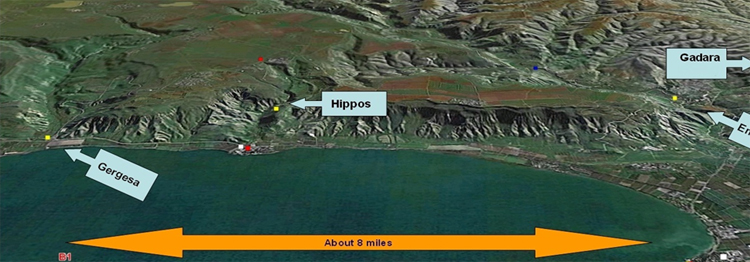
Upon examining the possible locations of Gadara and Gerasa, McRay [7] reasons both are very unlikely to be the setting; Gadara is five miles away from Galilee with the River Yarmuk running between them and Gerasa (modern Jerash) lies thirty-seven miles to the South East of Galilee. Both locations are too far for a herd of 2000 pigs to run to the Sea of Galilee. Can you imagine the herd running even five miles, crossing a river before heading into the Sea? ‘This leaves Gergesa, modern El Koursi [sic], on the E bank of the sea as the only reasonable possibility, if any credence is to be given to the geographical statements of the gospels.’ [8] Wessel [9] concurs that Koursi (sic) is a potential site, with a cliff forty metres from the shoreline and the presence of tombs.
It is worth also noting that the translated word ‘cliff’, kremnou, can also mean a steep bank or hillside [10], which fits the site of Gergesa with its steep hillsides much better than anywhere along the east coast of Galilee with a cliff as can be seen in the images below.
Origen, in his Commentary on John, Book VI, seems fit to point out that the etymology of the name Gergesa is important in locating this particular episode: ‘But Gergesa, from which the name Gergesenes is taken, is an old town in the neighbourhood of the lake now called Tiberias, and on the edge of it there is a steep place abutting on the lake, from which it is pointed out that the swine were cast down by the demons. The meaning of Gergesa is the dwelling of the casters-out, and it contains a prophetic reference to the conduct towards the Saviour of the citizens of those places, who besought Him to depart out of their coasts.’
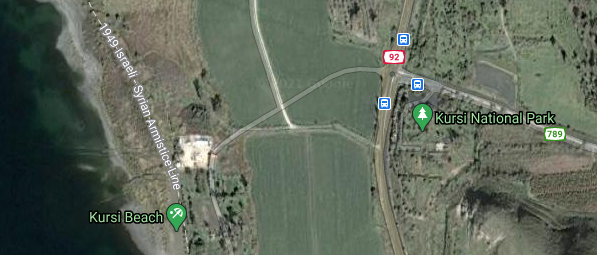
Here, we can see the flat plateaus where swineherds could be kept and the gap between that allowed access to the inner land. had a violent person been sat at the entrance to the gap, there would be an incentive to find other safe passage into the interior regions (as Matt 8:28 suggests), such as those at Hippos.
It is possible to visit El Kursi National Park via Google Maps, where one may wander around the recently discovered (in 1970) 5th to 6th Century Byzantine Christian monastery, built to commemorate the exorcism. If you look closely from within, you may observe the steep sides of the plateau running down to the sea, and view the mouths of tombs cut into the nearby hillside.
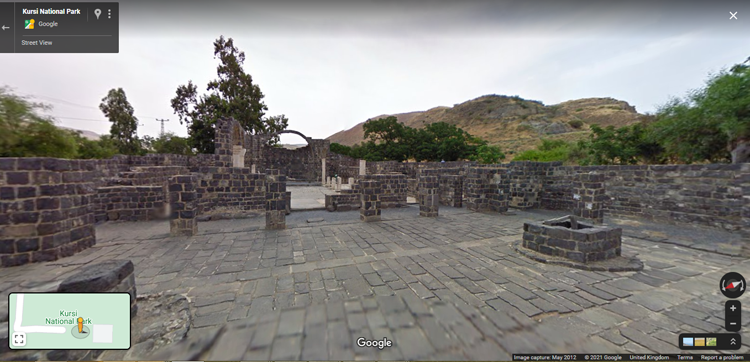
At this location one can imagine the Gadarene demoniac sitting in a tomb high above the shoreline, spotting Jesus’ boat approaching in the dark. He then runs down the hillside to meet him, exhibiting preternatural knowledge through his exclamation of Jesus’ title, “Son of the Most High” (v7 c.f. 1 Enoch 10:1). But enough of him for the moment.
The Political Landscape
The Gadarene Demoniac is set in a landscape scarred by much warfare and bloodshed. This cannot be forgotten and feeds directly into the situation Jesus faced upon meeting Legion:
- The Seleucid Empire had provided much Hellenization, and the infamously sacrilegious Antiochus Ephiphanes IV had girded the loins of the revolt of the Maccabeans to the South nearly 200 years earlier.
- Pompey’s Roman invasion and annexation of the Seleucid Empire occurred in 63BC [11]. This resulted in the reconfiguration of the Decapolis area [12].
- 67AD saw Vespasian send his infamous Legio X Fraternis, the Tenth Legion to put down a Galileean uprising across the Sea [13]. This resulted in 6500 Herodian nobles slaughtered in the lake at Magdala’s heavily fortified military port on the western side of Galilee, opposite Gergesa [14].
- The region was also seeded with various smaller rebellions of Jewish guerrilla fighters.
As a result of all this political unrest in the region some, such as Myers in his Binding the Strong Man, have chosen to interpret Mark primarily as a socio-political polemic against the Roman occupying forces that put down the rebellions of the Galileeans [15].
Myer’s work, derived from work by Duncan & Derrett [16], has great merit in taking note of the presence of the pigs and their association with the Roman occupation of the region, as well as the particularly militaristic words used by Jesus when speaking with the entities possessing the man [17]. We will explore these features of Mark’s account in a later part as they are part of the region’s bloody history.
Those suggesting the story of the Gadarene Demoniac is a political polemic are led to believe a link exists between the pigs and the supposed boar emblem of Legio X stationed nearby [18]. This would make sense if the story had in mind Vespasian’s drowning of the 6500 Jews across the Sea, for a legion was numerically similar in size [19]. Unfortunately, as Dando-Collins points out, Legio X stationed in the area around this time, had the emblem of the bull [20]. It was the 6th Legion, Ferrata (“Ironclads”), which had the emblem of the boar – and they weren’t in the region until nearly a century later, when they helped Legio X put down the second Jewish rebellion [21].
The polemic argument also depends upon the date of Mark’s composition after Vespasian’s activities in 67AD. Whilst some date Mark’s composition to this time period (due to Jesus’ words regarding the destruction of the Temple in Mark 13:1,2), it is possible that the writer of Mark recorded Jesus’ prophetic words before the destruction, and we can take the words with their true prophetic value. This, therefore, presents yet another challenge to the political interpretation.
Myers’ political interpretation also ignores the difficulties inherent with Jesus’ ministry not being about political kingdom building, such as his adamant refusal to ally his Kingdom with earthly kingdoms and power bases (Matthew 22:21; John 18:36; c.f. Paul’s later understanding of the Roman empire in Romans 13:1). Mark 12:13-17 also speaks of Jesus as upholding the existing ruling Roman authorities when he tells his listeners to pay their taxes to Caesar – hardly anti-Roman rhetoric. As such Mark’s account cannot simply be interpreted as a political polemic against Rome.
Twelftree dismisses the political lens, saying: ‘Contrary to the view of some modern interpreters, Mark portrays the demonic battle as being against Satan not Rome … for Mark, exorcism is significant because it both personalizes, as well as provides a cosmic arena to, the battle of ministry.’ [22] I have to agree with Twelftree [23] in that exorcism, as part of the healing and bringing in of the Kingdom of God, is the disciples’ only other assigned task apart from the proclamation of the message of Jesus’s death and resurrection, not political reformation. The Gadarene Demoniac cannot be a political polemic, and we miss much information about Jesus’ approach to spiritual warfare if we only use that interpretive lens.
Summary
In examining the background of the account of the Gadarene Demoniac, we have explored the region known as the Decapolis and examined the proposed locations for the event. Considering the four criteria mentioned, the most likely location is Gergesa on the edge of the Sea of Galilee. However, it is probably a battle not worth fighting to see the name changed from the Gadarene to Gergesene Demoniac.
The landscape itself has been soaked in blood due to political upheavals and rebellions. This will have impacted the spiritual dynamics involved in the event (as we shall later see).
Stationed nearby was at least one Roman Legion, Legio X Fraternis, which later had an emblem of a boar, but didn’t have this emblem at the time of the event, nor the Vespasian slaughter on the Sea. These may play a part in the story in a way which answers one of the most puzzling aspects of the story – why the wholesale destruction of the pigs?
In the next part – we shall explore the Gadarene demoniac himself: where he lived and what could have contributed to his terrible possession situation. See Part 2 of the Gadarene Demoniac Here.
Bibliography
Atkinson, K. (2016), ‘Jewish and Christian Texts Series, Vol. 23: A History of the Hasmonean State – Josephus and Beyond’, London: Bloomsbury T & T Clark.
Bolt, P. G. (1996), ‘Jesus, the Daimons and the Dead’, in Lane, A. N. S. The Unseen World. Grand Rapids, Michigan: Baker House Books and Paternoster Press, pp. 75-102.
Casey, M. (2010), ‘Jesus of Nazareth: An Independent Historians Account of His Life and Teaching’, London: T & T Clark International.
Dando-Collins, S, (2002). ‘Caesar’s Legion: The Epic Saga of Julius Caesar’s Elite Tenth Legion and the Armies of Rome’, New York: John Wiley & Sons Inc.
Duncan J., Derrett M. (1979), ‘Contributions to the Study of the Gerasene Demoniac’, Journal for the Study of the New Testament, May 1, pp. 2-17.
Johnston, M. (2007) ‘Engaging the Word: The New Church’s Teaching Series – Vol. 3’, Plymouth, UK: Cowley Publications.
McRay J. (1992) ‘Gerasenes’ in Freedman, D. The Anchor Bible Dictionary – Volume 2. New York, NY: Doubleday, pp. 991-992.
Myers, C. (2002). Binding the Strong Man: A Political Reading of Mark’s Story of Jesus. Maryknoll, New York: Orbis Books.
Twelftree, G. H. (2011), ‘Deliverance and Exorcism in the New Testament’, in Kay, W. K. and Parry, P., Exorcism and Deliverance: Multidisciplinary Studies, Milton Keynes: Paternoster, pp. 45-68.
Wessel, W. W. (1984), ‘Mark’, in Gæbelein F. E. (ed) The Expositor’s Bible Commentary: Volume 8. Grand Rapids, Michigan: Zondervan Publishing.
Footnotes
[1] Shakespeare, Twelfth Night III.4.1631: ‘Which way is he, in the name of sanctity? If all the devils of hell be drawn in little, and Legion himself possessed him, yet I’ll speak to him.’
[2] IMDb. 2021. “Red Dwarf” Legion (TV Episode 1993) – IMDb. [online] Available at: <https://www.imdb.com/title/tt0684163/> [Accessed 16 March 2021].
[3] Myers,190.
[4] Johnston, 55.
[5] Bolt, 98.
[6] Myers, 190.
[7] McRay, 991.
[8] Ibid.
[9] Wessel, 657.
[10] StudyLight.org. 2021. Strong’s #2911 – κρημνός – Old & New Testament Greek Lexicon. [online] Available at: https://www.studylight.org/lexicons/greek/2911.html [Accessed 16 Mar. 2021].
[11] Atkinson, 97.
[12] Atkinson,152 n.28.
[13] Dando-Collins, 224-227.
[14] Myers, 191; Josephus, War III:522-531.
[15] Johnston, 58; Myers, 191.
[16] Duncan & Derrett, 5-6.
[17] Myers, 190-192,194.
[18] Casey, 243.
[19] Penelope.uchicago.edu. 2021. The Roman Legion. [online] Available at: <https://penelope.uchicago.edu/~grout/encyclopaedia_romana/britannia/wales/legio.html> [Accessed 16 March 2021].
[20] Dando-Collins, 285-286.
[21] Ibid., 265-267.
[22] Twelftree, 59.
[23] Ibid., 59-60.


best articel, good